
At a time when Apple delivered its flagship line of new products on schedule despite battling a year of supply-chain turmoil, India could account for at least 12 per cent of the free-on-board (FoB) value of Apple Inc's iPhones manufactured by its vendors globally by 2025-26 (FY26). The number represents a significant shift for the Cupertino-based company's over-dependence on China, where 95 per cent of its phones are still being made. India's growing importance can be seen from the fact that in 2021-22 (FY22) - the first year of the production-linked incentive (PLI) scheme (the scheme was extended by a year due to the pandemic) - the FoB value of iPhones made in the country was $1.75 billion, translating into less than 2 per cent of the global value.

Indian plants -- who plan to begin production with 28 nano metre chips -- will take two to four years to get off the ground. By that time, in the fast changing world of chip making, the global market would have shifted to 22 nm.

This would be India's largest crowd-funded programme to help patients with a particular disease.

Reliance Jio is close to finalising its contract with telecom gear maker Ericsson to roll out its 5G network in Mumbai and Maharashtra and Kolkata and West Bengal in the first phase of its launch in October. And it is going with Nokia for the lucrative Delhi circle, and Chennai, which includes Tamil Nadu, say sources aware of the development. This is the first time that Jio is opting for multiple vendors.

A few days ago, Reliance Retail surprised the market by acquiring the Campa brand from Delhi-based Pure Drinks Ltd for Rs 22 crore. A successful cola brand in the eighties, especially in North India, Campa Cola thrived when Coke exited India in the late seventies. When the Atlanta-based major returned and PepsiCo set base in India, it went down fighting.

As many as 34 new drugs were added to and 26 dropped from an updated list of essential medicines on Tuesday, with the government saying this will reduce "patients' out-of-pocket expenditure". The National List of Essential Medicines (NLEM 2022) has 384 drugs, up from 376 in 2015. "Drafting this list is a lengthy process, and around 350 experts from across India have held over 140 consultation meetings to draft the NLEM 2022," Union Health Minister Mansukh Mandaviya said.

'It leads to more investment, more money put in R&D, expansion and modernisation.'

'Just put a patch on your arm and the vaccine can be absorbed by the body.'

Just a few weeks ago, Communications Minister Ashwini Vaishnaw did some tough talking with the senior managers of Bharat Sanchar Nigam Ltd, the ailing state-owned telecom service provider. The message was clear: They had to perform, quit by taking the voluntary retirement package or be compulsorily retired from service. The terse message from an otherwise polite and soft-spoken minister came just days after he announced a second and bigger package of Rs 1.64 trillion as part of a four-year turnaround plan for BSNL.

Reliance Jio's aggressive target to reach 100 million households through the launch of the 5G fixed wireless access (FWA) could make it one of the world's largest players in this space. But this also marks a change from its earlier strategy of offering fibre-to-the home (FTTH) broadband to households. Despite its best efforts, in two years Jio has been able to connect only 7 million households with FTTH, as permission for right of way for the last mile became a major impediment and the process of laying ducts for the roll-out was slow and cumbersome.

The merits and demerits of the telcos' 5G strategy however is clearly dependent on the financial muscle of players, reports Surajeet Das Gupta.

Telecom gear makers say will take six to eight months for the top 10 cities to have some reasonable coverage of 5G network services.
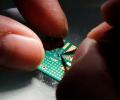
Foundries in Taiwan account for more than 75 per cent of the chips that mobile devices made in India need, according to estimates by the Indian Cellular and Electronics Association (ICEA), which represents global and domestic manufacturers. The number is slightly lower, 60 per cent, if one considers all chips -- those of consumer electronics, PCs, laptops, autos, etc. This ties in with the fact that foundries in Taiwan, led by TSMC, account for over 70 per cent of the world's microchip supply, according to estimates by Gartner.

How dominant are Chinese firms in India's sub-Rs 10,000 mobile device market? The question has become relevant as the government has been thinking of reserving this price segment for domestic players who have not been able to battle the Chinese onslaught. However, telecom firms and others are concerned that such a move could stymie the effort to build affordable 5G phones in the sub-Rs 10,000 category.

'By the end of 2022, we expect the installed base of 5G smartphones in India to reach 80-85 million.'

'Gift-giving' - from free dinners and drug samples to promotional merchandise - seems to be driving drugmakers' marketing - a marketing prescription deeply entrenched in the industry. This is a well-oiled racket that sees pharmaceutical (pharma) companies 'gifting' doctors to push their respective drugs under the guise of marketing. But is there a cure in sight to end this unhealthy alliance? The recent controversy following the income-tax raids on Bengaluru-based drugmaker Micro Labs, makers of popular paracetamol brand Dolo-650, has brought this to the fore, again.

'The tie-up with Serum Institute Life Sciences brings to the table their strengths in manufacturing and also their vaccine portfolio.'

The government is busy strategising ways to revive the domestic mobile device industry as Chinese firms have grabbed a large chunk of the handset market. The idea is to minimise competition from Chinese mobile players in the entry level or sub-Rs 10,000 category, according to a senior government official familiar with the plans. While discussions on the strategy are on, there's a growing consensus within the government that the lower end of the market should be reserved only for the domestic players, the official said.

'There were two options before the government -- create a complex, cumbersome law, which will cause a tremendous amount of compliance challenges for startups or say let's go back and do a clean slate, where we do a framework of laws and policies'
It came as a surprise to all stakeholders - competing telecom companies (telcos), most analysts and even the government's internal projections on revenues from the 5G auctions. Reliance Jio disrupted all calculations by paying a stiff Rs 40,000 crore to buy 10 MHz of spectrum in the 700-MHz band, globally considered a key band for efficient 5G service coverage, along with the default 3.5 GHz band and the ultra-high speed and low-latency millimetre band of 26 GHz band. So what made Jio pay almost 45 per cent of its total spend in this auction for the 700 MHz band - much more than what it rustled up even for the 3.5 GHz band?
